
You’ve seen the claim in a forum thread: a speed booster adds a full stop of light. Then someone replies that it adds nothing, and a third person says it’s just a fancy adapter. So who’s right, and what is a speed booster in the first place?
Here’s the short version. A speed booster (focal reducer) is an optical adapter that sits between a lens and a mirrorless camera. It shrinks the image the lens projects so a smaller sensor can use more of it. That makes the lens wider and faster, but it doesn’t make the lens collect more light, which is why the arguments never end. The name isn’t generic everywhere, either. Speed Booster is Metabones’ product name, and other makers sell the same idea as focal reducers, Lens Turbos or accelerators.
This page covers what a speed booster is, how it works and what it does to your lens, then shows how it differs from a plain adapter and a teleconverter. You’ll also get a compatibility table, the downsides reviewers report, a short history and a straight answer on whether one is worth buying. Every number comes from a formula you can rerun. If you want the maths first, start with the guide to speed booster effective aperture, then come back here for the big picture.
Last updated:
- What Is a Speed Booster?
- How Does a Speed Booster Work?
- What Does a Speed Booster Do to Your Lens?
- How Is a Speed Booster Different From a Plain Adapter?
- Which Cameras and Lenses Can Use a Speed Booster?
- Quick Answers About Speed Boosters
- What Are the Downsides of a Speed Booster?
- Is a Speed Booster Worth It?
- Where Did the Speed Booster Come From?
- Frequently Asked Questions
What Is a Speed Booster?
A speed booster is a lens adapter with glass inside it that shrinks the image a lens projects, so a smaller camera sensor can use more of that image. It sits between the lens and a mirrorless camera body, and it multiplies the lens’s focal length and f-number by a fixed ratio, such as 0.71×.
Simply put, it’s a teleconverter in reverse. A teleconverter magnifies the image (a ratio above 1), and a speed booster compresses it (a ratio below 1). The Speed Booster white paper, written by lens designer Brian Caldwell and engineer Wilfried Bittner, describes a focal reducer as a positive lens behind the main lens that shortens the focal length and leaves the lens opening alone. That’s the whole idea in one sentence.
Is a Speed Booster the Same as a Focal Reducer?
Optically, yes. Focal reducer and telecompressor are the generic names, and Wikipedia’s entry on the telecompressor describes Speed Booster as the commercial name of Metabones’ line. B&H’s guide to speed boosters adds that, depending on the brand, these adapters are called Accelerators, Speed Boosters or Turbos, and that the Metabones name has become close to a synonym for the whole type. So the label changes while the optical idea stays the same.
How Does a Speed Booster Work?
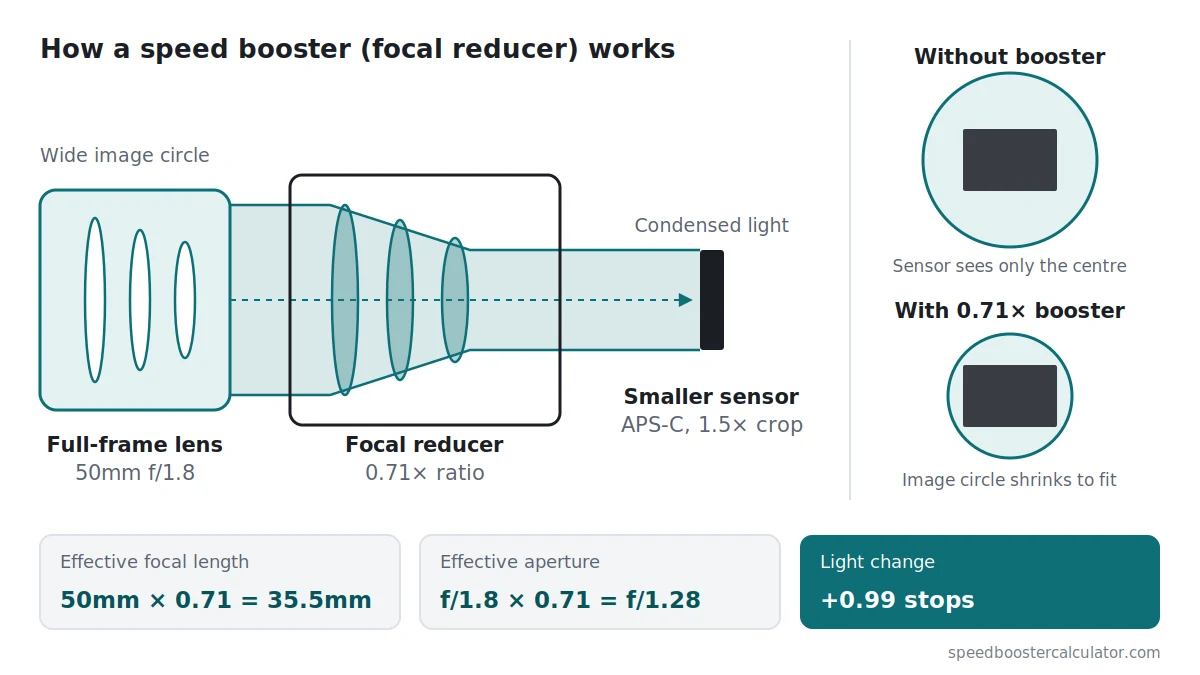
A speed booster compresses the lens’s image circle with a group of lens elements, so the same picture lands on a smaller area. The sensor records that shrunken picture, which is why the view gets wider and the image gets brighter per square millimetre.
Simply put, an f-number is the focal length divided by the diameter of the lens’s entrance pupil, its effective opening. The booster shortens the focal length and doesn’t touch the opening, so the f-number falls by the same ratio. The white paper makes the same point for a 0.7× reducer. Here’s what that does to a 50mm f/1.8 lens behind a 0.71× booster:
| Property | Without a booster | With a 0.71× booster | What changed |
|---|---|---|---|
| Focal length | 50mm | 35.5mm | × 0.71 |
| F-number at the sensor | f/1.8 | f/1.28 | × 0.71 |
| Entrance pupil (the opening) | 27.8mm | 27.8mm | No change |
| Image circle from a full-frame lens | 43.3mm | 30.7mm | × 0.71 |
| Exposure | Baseline | +0.99 stops | Brighter image |
Why Does the Lens Need a Big Image Circle?
Because the booster shrinks the circle, and the shrunken circle still has to cover the sensor. A full-frame lens projects a circle about 43.3mm across, and a 0.71× booster cuts that to 30.7mm. The white paper gives a neat example: a 0.7× reducer on a sensor with a 28mm diagonal needs a lens that covers about 40mm, which full-frame SLR lenses easily do. A lens built for a smaller sensor has less room to shrink.
Two Ways to Picture the Same Effect
You can say the booster makes your sensor look bigger, or you can say it changes your lens. On Micro Four Thirds, a 17.3 × 13mm sensor behaves like a 24.4 × 18.3mm sensor behind the original lens, or the 50mm f/1.8 becomes a 35.5mm f/1.28 on the real sensor. Both descriptions are correct. Most speed booster arguments start when people mix the two in one sentence.
Pick one picture and stick with it, and the numbers always agree.
What Does a Speed Booster Do to Your Lens?
It makes the lens wider and faster. A 0.71× booster turns a 50mm f/1.8 lens into 35.5mm f/1.28 and adds about +0.99 stops of exposure. On a 1.5× APS-C camera the combined crop factor falls from 1.5 to about 1.07, so the view comes close to full frame.
What it doesn’t do is add total light. Here’s the effect in one table, with the baseline named for each row, because most disagreements disappear once you say what you’re comparing against.
| Question | With a 0.71× booster | Compared with |
|---|---|---|
| Is the view wider? | Yes. A 50mm lens frames like 35.5mm | The same lens on a plain adapter |
| Is the image brighter? | Yes, about +0.99 stops | The same lens on the same camera, plain adapter |
| Does the lens collect more total light? | No. The opening is the same size | The same lens before the booster |
| Is depth of field shallower? | At the same framing, yes. At the same distance, no | The same lens without the booster |
| Is the picture sharper? | It depends on the lens and the adapter | The same lens on a plain adapter |
There are two f-numbers to keep apart. On a 1.5× APS-C camera, a 50mm f/1.8 lens with a 0.71× booster exposes like f/1.28, but its full-frame equivalent for depth of field is f/1.92. Quote f/1.28 when you talk about shutter speed, and f/1.92 when you talk about background blur. We settle the argument properly in do speed boosters really add light.
A speed booster widens the view and speeds up the lens, and it leaves the total light alone.
How Is a Speed Booster Different From a Plain Adapter?
A plain adapter only changes the mount, while a speed booster also changes the image. B&H describes standard adapters as devoid of optical elements, basically metal and plastic tubes that join a lens and camera with different mounts. A speed booster adds glass and a ratio below 1, and a teleconverter adds glass and a ratio above 1.
| Setup (50mm f/1.8 lens on a 1.5× APS-C camera) | Lens becomes | Full-frame equivalent | Light vs plain adapter |
|---|---|---|---|
| Plain adapter (1.0×) | 50mm f/1.8 | 75mm f/2.7 | Baseline |
| 0.71× speed booster | 35.5mm f/1.28 | 53.25mm f/1.92 | +0.99 stops |
| 1.4× teleconverter | 70mm f/2.52 | 105mm f/3.78 | −0.97 stops |
That’s why people reach for a booster when they adapt a favourite full-frame lens to a crop-sensor camera. With a plain adapter, a 50mm lens on APS-C frames like a 75mm lens. With a 0.71× booster it frames like about 53mm, which is much closer to the field of view you bought the lens for.
One adapter changes where the lens fits, and the other also changes what the sensor sees.
Which Cameras and Lenses Can Use a Speed Booster?
A mirrorless camera with a sensor smaller than the lens’s image circle, used with a lens designed for a larger sensor. Typical pairings are full-frame lenses on APS-C, Super 35 or Micro Four Thirds cameras.
Simply put, a booster needs room behind the lens, and only mirrorless cameras have it. The white paper compares flange distances: about 20mm on Micro Four Thirds and about 18mm on the Sony NEX, against 46.5mm for Nikon F. The shorter mirrorless distance leaves space for the optics, and a DSLR’s mirror takes that space away. The Metabones FAQ covers the rest in plain terms.
| Your setup | Does a speed booster work? | Why |
|---|---|---|
| Full-frame lens on a mirrorless APS-C or Micro Four Thirds camera | Yes, the intended use | The lens’s image circle is bigger than the sensor, and there is room behind the lens |
| DSLR body | No | Metabones says the mirror gets in the way and there is no room for the optics |
| Full-frame mirrorless body | Not normally | The shrunken image circle no longer covers the sensor. Metabones lists its boosters as incompatible with Sony E-mount full-frame bodies |
| Rangefinder lens | No | Metabones says there is not enough room, so it needs an SLR-type lens |
| Lens built for a smaller sensor (APS-C) | Depends | Its image circle is smaller, so it may not cover the sensor once shrunk. Test it first |
| Lens with a rear element that sticks out | Check first | Metabones warns that some lenses can touch the booster’s glass |
Check three things before you buy: the lens mount, the camera mount and the image circle.
Quick Answers About Speed Boosters
What Is a Speed Booster in Simple Terms?
Simply put, it’s a lens adapter with glass inside that squeezes a big image onto a smaller sensor. The lens ends up with a shorter focal length and a lower f-number, so you get a wider, brighter picture from the lenses you already own. It matters most when you adapt full-frame lenses to a crop-sensor mirrorless camera.
Speed Boosters at a Glance
| Aspect | Details |
|---|---|
| Symptom | An adapted lens frames tighter and is slower than you want on a crop-sensor camera |
| Root Cause | The smaller sensor sees only part of the larger image the lens projects |
| Fix | A speed booster compresses the image circle by its ratio, such as 0.71× |
| Result | A 50mm f/1.8 lens becomes 35.5mm f/1.28 (+0.99 stops), and a 1.5× APS-C crop falls to about 1.07× |
| Applies To | Mirrorless cameras with a sensor smaller than the lens’s image circle, such as APS-C, Super 35 and Micro Four Thirds |
When Does This Apply?
It applies when you adapt a lens made for a larger sensor to a smaller-sensor mirrorless camera. It doesn’t apply to native lenses, to DSLRs or to a plain adapter with no glass.
Pros and Cons of a Speed Booster
- Pro: wider view from lenses you already own, close to full frame on APS-C
- Pro: about one stop more exposure at 0.71×, for a faster shutter or lower ISO
- Pro: one lens works two ways: plain adapter for reach, booster for width
- Con: extra glass can soften corners and add colour fringing
- Con: adds weight, and some versions have no electronic contacts
- Con: works only on mirrorless cameras, and each model fits one lens mount and one camera mount
What Are the Downsides of a Speed Booster?
The extra glass can cost you some sharpness at the edges, and it adds weight and, on some models, limits electronics. How much depends on the lens and the adapter, so judge each setup against the same lens on a plain adapter.
Reviewers don’t agree on image quality, and that’s fair. The designers’ white paper argues that compressing the image shrinks the lens’s aberrations and can raise MTF, a measure of contrast and sharpness. B&H’s author tested a Metabones Speed Booster ULTRA and a Mitakon Zhongyi Lens Turbo and found centre sharpness virtually unaffected, with corners suffering a bit and a little more colour aberration. Both can be true, because the result depends on the lens and the adapter. Test your own pair at the apertures you use.
There are practical limits, too. The Metabones FAQ says its Nikon G version has no electrical contacts and no autofocus, and it warns that a booster also moves the smallest aperture, so f/22 turns into about f/15.6 at 0.71×. Boosters add bulk, and a camera may display the original aperture for fast lenses even though the real one is faster.
Most downsides are small and checkable, so test the lens and adapter you plan to buy.
Is a Speed Booster Worth It?
It’s worth it if you adapt lenses made for a larger sensor and want their wider view and extra speed back. It’s probably not worth it if you only use native lenses, shoot on full frame or rely on fast autofocus.
Ask yourself four questions:
- Do you own lenses made for a larger sensor than your camera has?
- Do you miss the field of view those lenses give on full frame?
- Are you happy to focus manually, or to accept limited electronics?
- Can you live with a little edge softness for a wider, faster lens?
Here’s what it buys you. A full-frame 24mm f/1.4 lens on 1.5× APS-C frames like 36mm and behaves like f/2.1 in full-frame terms. Add a 0.71× booster and it frames like about 25.56mm and behaves like f/1.49, close to the lens you bought. Adapters and prices change, so check the maker’s current listing in 2026 before you commit.
Four yes answers mean a booster fits, and one or two usually mean a plain adapter is enough.
Where Did the Speed Booster Come From?
The idea is old, and mirrorless cameras made it practical for everyday lenses. The white paper traces focal reducers back to telescopes and notes that lens designers have used meniscus lenses to shorten focal length and speed up lenses for more than a century. It also mentions a Zeiss 50mm f/0.7 lens, built with an integrated focal reducer for NASA and later adapted by Stanley Kubrick for candle-lit scenes in Barry Lyndon.
What changed was the camera. Mirrorless bodies have a short distance between the mount and the sensor, so there’s room for a focal reducer behind an SLR lens. The authors describe their Speed Booster as the first general-purpose focal reducer for SLR lenses on mirrorless cameras, and Metabones went on to sell it.
The optics are old, and the mirrorless flange distance is what finally made them useful.
Frequently Asked Questions
What is the purpose of a speed booster?
It lets you use lenses made for a larger sensor on a smaller-sensor mirrorless camera while winning back some field of view and speed. A 0.71× booster gives a wider view than a plain adapter and about a one-stop brighter image.
Is a speed booster the same as a focal reducer?
Optically, yes. Focal reducer and telecompressor are the generic names, and Speed Booster is the name Metabones uses for its line. Other makers use names such as Lens Turbo, so the maths is the same whatever the label.
Is Speed Booster a brand name?
Yes. B&H describes it as a Metabones brand trademark that has become close to a synonym for the whole type of adapter. If you're searching for products from any maker, focal reducer is the safer term.
Who designed the Speed Booster?
Metabones' white paper credits lens designer Brian Caldwell and engineer Wilfried Bittner as its authors. They describe it as the first general-purpose focal reducer for SLR lenses on mirrorless cameras. Metabones sells the adapters.
Do speed boosters work on DSLR cameras?
No. Metabones says the mirror gets in the way and there is no room for the optics. Speed boosters are made for mirrorless cameras, which have a much shorter distance between the lens mount and the sensor.
What is the difference between a speed booster and a normal lens adapter?
A normal adapter is an empty tube that only changes the mount, so the lens keeps its focal length and f-number. A speed booster adds glass that shrinks the image, so both numbers drop by the ratio.
Is a speed booster the opposite of a teleconverter?
Almost. Both are rear optical attachments, but a teleconverter has a ratio above 1, so it lengthens the focal length and slows the lens. A speed booster has a ratio below 1, so it does the reverse.
Do I need a different speed booster for each camera?
Usually, yes. Each model joins one lens mount to one camera mount, such as Nikon F to Fujifilm X, and the ratio suits a sensor size. Check that the lens mount, camera mount and image circle all match before buying.
Can I use old manual lenses with a speed booster?
Often, yes, if the booster has the right lens mount and the lens doesn't stick out at the rear. Metabones warns that some manual lenses can touch the booster's glass, so check the maker's compatibility list first.
So, what is a speed booster? It’s a focal reducer in a lens adapter: glass that compresses the lens’s image so a smaller sensor can use more of it. A 0.71× booster turns a 50mm f/1.8 lens into 35.5mm f/1.28, adds about one stop of exposure and takes a 1.5× APS-C crop down to about 1.07. It doesn’t add total light, and it works only on mirrorless cameras with the right mounts and a big enough image circle.
It’s one more piece of the lens-maths picture: how focal length, aperture and crop factor combine when you adapt lenses across sensor sizes. Adapters keep changing, so check the maker’s current spec sheet in 2026 before you buy, and trust your own meter over the number on the screen.
To see the numbers for your own lens and camera, open the speed booster calculator. Bookmark this page for the plain-English version, and share it with the friend who keeps asking what that adapter does.