
Does a speed booster make APS-C full frame? You’ll hear yes, no and “sort of”, often in the same thread. One video says a booster gives you the full-frame look for the price of an adapter. A forum reply calls that marketing. Then someone notices that a 50mm f/1.2 lens suddenly behaves like f/0.85 and wonders if physics has broken.
Nothing is broken. People are answering different questions against different baselines. A speed booster changes your field of view, your exposure and your depth of field by different amounts, and none of them equals the jump in sensor size. Put the numbers side by side and most of the argument ends.
That’s what this page does. You’ll see how close a 0.71× booster gets an APS-C or Micro Four Thirds camera to full frame, which f-number to use for exposure and which for background blur, and how depth of field moves when you hold the distance or the framing. You’ll also get the low-light maths: how much total light a boosted camera collects compared with a full-frame body. If you only need the plain conversion without a booster, start with the APS-C to full frame calculator, then come back for the booster layer.
Last updated:
- Does a Speed Booster Make APS-C Full Frame?
- Which f-Number Do You Use: Exposure or Full-Frame Equivalent?
- Speed Booster Depth of Field: Same Distance or Same Framing?
- Does a Boosted APS-C Camera Match Full Frame in Low Light?
- Quick Answers About Speed Booster Equivalence
- Is a 50mm f/1.2 With a 0.71× Booster Really a 35mm f/0.9 Lens?
- Can a Speed Booster Make Micro Four Thirds Full Frame?
- Frequently Asked Questions
Does a Speed Booster Make APS-C Full Frame?
Not literally, but it gets close. The sensor stays APS-C. What changes is the combined crop factor: a 0.71× booster takes a 1.5× APS-C camera to about 1.07× and a 1.6× Canon camera to about 1.14×.
Simply put, a booster doesn’t enlarge your sensor, it shrinks the lens’s image so the sensor sees more of it. That recovers nearly all of a full-frame view and about one stop of exposure. It can’t give back the sensor area you don’t have, so some differences in total light remain.
| Camera | Crop factor | With 0.71× | With 0.64× | Ratio for exactly 1.0× |
|---|---|---|---|---|
| APS-C (Sony, Nikon, Fujifilm) | 1.5 | 1.07 | 0.96* | 0.67× |
| APS-C (Canon) | 1.6 | 1.14 | 1.02 | 0.63× |
| Micro Four Thirds | 2.0 | 1.42 | 1.28 | 0.5× |
*A combined crop below 1.0 would need more image circle than a full-frame lens projects, so the corners vignette in practice. You’ll see 1.07, 1.08 and 1.09 quoted for APS-C. They differ because the crop factor itself is rounded: 1.5 gives 1.065, the Metabones FAQ uses 1.52 and gets about 1.08, and the exact 23.5mm sensor width gives about 1.09. Pick one value and stay consistent.
The honest answer is a full-frame field of view, yes, and a full-frame sensor, no.
Which f-Number Do You Use: Exposure or Full-Frame Equivalent?
Use the booster’s f-number for exposure, and the full-frame equivalent f-number for depth of field and total light. On a 1.5× APS-C camera, a 50mm f/1.8 lens with a 0.71× booster exposes like f/1.28 but gives the background blur and total light of about f/1.92 on full frame.
Simply put, there are three rules. The exposure f-number is the lens f-number × ratio. The full-frame equivalent f-number is that value × the camera’s crop factor. The equivalent ISO is your ISO × the crop factor squared, and the shutter speed stays the same. This is the standard idea of photographic equivalence, which Joseph James explains well: matching field of view, aperture diameter and shutter speed gives matching total light.
| Lens | Exposure f-number with 0.71× | 1.5× APS-C: full-frame equivalent | 2.0× Micro Four Thirds: full-frame equivalent |
|---|---|---|---|
| 50mm f/1.8 | f/1.28 | 53.25mm f/1.92 | 71mm f/2.56 |
| 50mm f/1.4 | f/0.99 | 53.25mm f/1.49 | 71mm f/1.99 |
| 50mm f/1.2 | f/0.85 | 53.25mm f/1.28 | 71mm f/1.7 |
| 85mm f/1.4 | f/0.99 | 90.53mm f/1.49 | 120.7mm f/1.99 |
Here’s the mix-up to avoid. A Micro Four Thirds shooter reads “f/3.6 equivalent” for a 50mm f/1.8 lens, adds a 0.71× booster, sees “f/1.28” and decides the booster made the lens 2.8 stops faster. It didn’t. The two numbers answer different questions. With the booster, the equivalent figure is f/2.56, and 3.6 to 2.56 is exactly the one stop you’d expect.
One lens gives you two f-numbers, so always say which question you’re asking.
Speed Booster Depth of Field: Same Distance or Same Framing?
It depends on what you hold constant. If you stay where you are, depth of field gets deeper by about 1.4×. If you step closer to keep the same framing, it gets shallower by about 1.4×.
That’s why two respectable sources seem to disagree. B&H’s guide says the lens’s depth of field is unchanged, and its example is a boosted 50mm f/2 matching a native 35mm f/1.4 at the same focus distance. That’s right, but it compares the booster with a different lens. The Metabones FAQ says that on APS-C the booster gives essentially the same depth-of-field effect as full frame. It also notes that “unchanged” claims quietly assume the same distance and the same circle of confusion.
Let’s settle it with numbers. For subjects well inside the hyperfocal distance, depth of field is roughly 2 × f-number × c × distance² ÷ focal length², where c is the circle of confusion. Here’s a 50mm f/1.8 lens on an APS-C camera, with c = 0.02mm for the sensor. The booster doesn’t change the sensor, so c stays the same.
| Setup (APS-C, c = 0.02mm) | Lens at the sensor | Subject distance | Approximate depth of field |
|---|---|---|---|
| No booster | 50mm f/1.8 | 3m | 26cm |
| 0.71× booster, same position | 35.5mm f/1.28 | 3m | 37cm (deeper) |
| 0.71× booster, step closer to match framing | 35.5mm f/1.28 | 2.13m | 18cm (shallower) |
The wider view lowers the magnification, so the same spot looks deeper. Walk forward until the subject fills the frame again, and the blur comes back and then some. Both statements are true, and that’s the full story. We cover the extra-stop side of the argument in do speed boosters really add light.
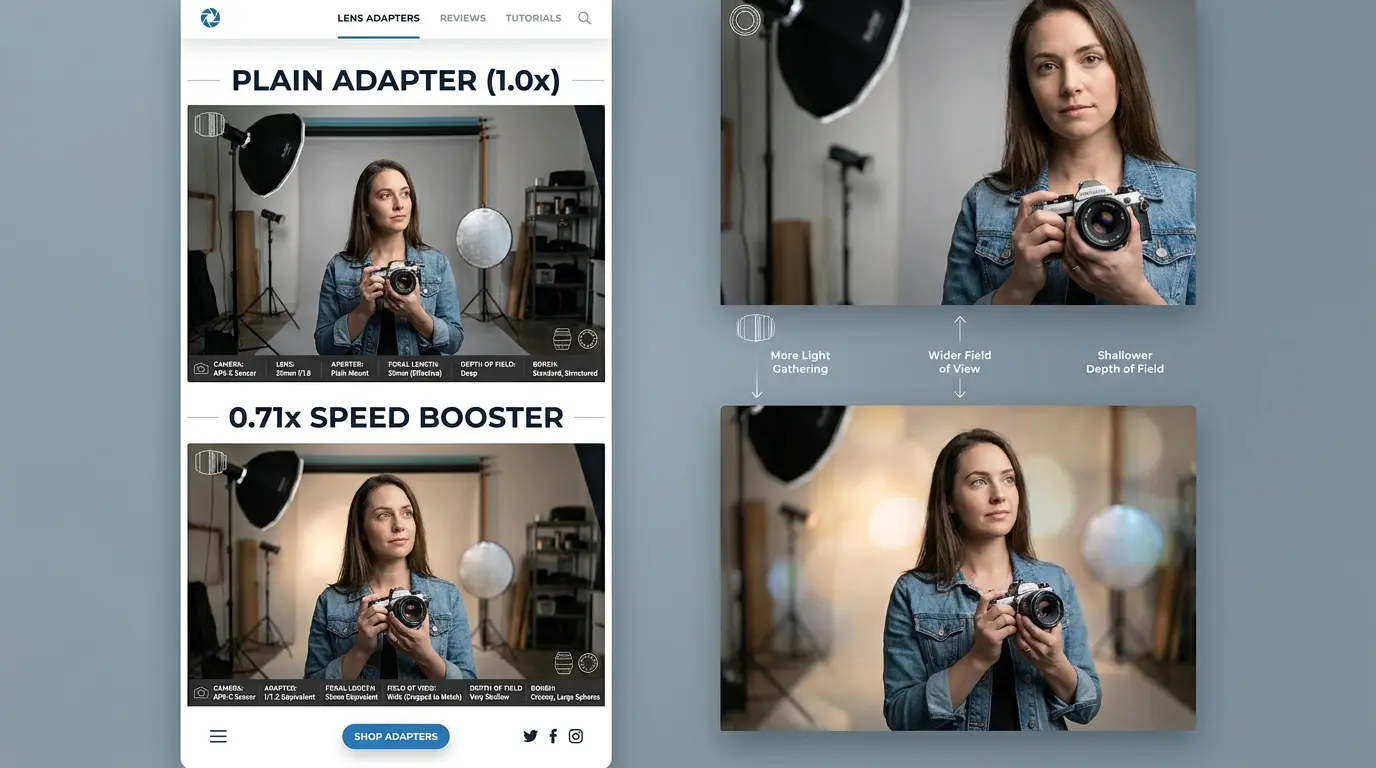
Depth of field only looks shallower once you match the framing.
Does a Boosted APS-C Camera Match Full Frame in Low Light?
A 0.71× booster brings a 1.5× APS-C camera within about 1/6 stop of full frame in total light. A Micro Four Thirds camera with the same booster still sits about one stop behind.
Simply put, total light is how much light the sensor collects from the scene, and a wider field of view collects more. The booster widens the view of a small sensor by 1 ÷ ratio in each direction, so the area it sees grows by 1 ÷ ratio². Divide that by the camera’s crop factor squared and you get the share of full-frame light.
| Setup | Total light vs full frame (same lens, same shutter speed) | Difference in stops |
|---|---|---|
| 1.5× APS-C, no booster | 44% | −1.17 |
| 1.5× APS-C, 0.71× booster | 88% | −0.18 |
| 1.6× Canon APS-C, no booster | 39% | −1.36 |
| 1.6× Canon APS-C, 0.71× booster | 77% | −0.37 |
| 2.0× Micro Four Thirds, no booster | 25% | −2.0 |
| 2.0× Micro Four Thirds, 0.71× booster | 50% | −1.01 |
| 2.0× Micro Four Thirds, 0.64× booster | 61% | −0.71 |
Now put it into ISO. Say a full-frame camera needs ISO 1600 at f/1.8. The same 50mm lens on APS-C without a booster also needs ISO 1600, but its noise behaves like full-frame ISO 3600 (1600 × 2.25). With a 0.71× booster you can drop to about ISO 800 for the same brightness, and the noise behaves like full-frame ISO 1800. That’s within about 1/6 stop of the native full-frame shot.
Treat these figures as the ideal case. They assume sensors of similar technology, and the adapter’s glass absorbs a little light, so check T-stop data when the maker publishes it. Real cameras differ in other ways too, so a table can’t promise identical noise.
The booster closes most of the low-light gap on APS-C and only half of it on Micro Four Thirds.
Quick Answers About Speed Booster Equivalence
What Does “Full-Frame Equivalent” Mean With a Speed Booster?
Simply put, a full-frame equivalent is the full-frame lens and settings that would give the same picture as your boosted camera: the same field of view, depth of field and shutter speed, with similar noise. You build it by multiplying the booster’s focal length and f-number by the crop factor, and the ISO by its square. It matters when you compare systems, not when you set exposure.
Speed Booster Equivalence at a Glance
| Aspect | Details |
|---|---|
| Symptom | Claims that a booster makes APS-C “full frame” or a lens “f/0.9” sound either too good or like marketing |
| Root Cause | One lens has three different f-numbers (exposure, depth of field and total light), and people compare against different baselines |
| Fix | Use the exposure f-number for exposure, the equivalent f-number for blur and total light, and the equivalent ISO for noise |
| Result | 0.71× on 1.5× APS-C: f/1.28 exposure, 53.25mm f/1.92 equivalent, about 0.18 stops short of full-frame total light |
| Applies To | Mirrorless APS-C, Super 35 and Micro Four Thirds cameras using lenses made for full frame |
When Does This Apply?
It applies when you compare a boosted camera with a full-frame setup: choosing a system, matching a look or reading a review. It doesn’t apply to exposure on your own camera, which follows the lens’s boosted f-number, or to native lenses.
Is a 50mm f/1.2 With a 0.71× Booster Really a 35mm f/0.9 Lens?
For exposure, yes. For the full-frame look, no. A 50mm f/1.2 lens behind a 0.71× booster exposes like a 35.5mm f/0.85 lens, but on a 1.5× APS-C camera it gives the depth of field and total light of a 53.25mm f/1.28 lens on full frame.
So the headlines aren’t lying. They’re answering “faster than what?” The Metabones FAQ points out that a boosted 50mm f/1.4 behaves like a 35mm f/1.0 lens, and that always has shallower depth of field than a native 35mm f/1.4 on the same camera. Compared with the native lenses available for that body, the booster really does win. Compared with the same lens on full frame, it only gets close.
Faster than the native options is a fair claim, and faster than full frame isn’t.
Can a Speed Booster Make Micro Four Thirds Full Frame?
Not quite: a 0.71× booster takes Micro Four Thirds from 2.0× to 1.42×, and a 0.64× booster to 1.28×. That’s closer to APS-C than to full frame.
| 50mm f/1.8 on Micro Four Thirds | Lens at the sensor | Full-frame equivalent | Total light vs full frame |
|---|---|---|---|
| No booster | 50mm f/1.8 | 100mm f/3.6 | 25% |
| 0.71× booster | 35.5mm f/1.28 | 71mm f/2.56 | 50% |
| 0.64× booster | 32mm f/1.15 | 64mm f/2.3 | 61% |
A true full-frame view would need 0.5×, which shrinks a full-frame image circle to about 21.7mm, barely the 21.6mm diagonal of the sensor. The Metabones FAQ adds a practical limit: its 0.71× is the ratio that suits the widest range of Micro Four Thirds cameras, and the 0.64× XL has a rear element that doesn’t fit every body.
Micro Four Thirds gets noticeably closer to full frame with a booster, but it still stops well short.
Frequently Asked Questions
Why do people say a speed booster makes APS-C like full frame?
Because it recovers most of a full-frame view: a 0.71× booster takes a 1.5× crop to about 1.07×. People stretch that to "full frame", but the sensor area, and so total light, stays smaller. Judge field of view, depth of field and noise separately.
Does a speed booster give APS-C the same low-light noise as full frame?
Close, not identical. With a 0.71× booster a 1.5× APS-C camera collects about 88% of full-frame total light, roughly 0.18 stops less. A 1.6× Canon camera is about 0.37 stops behind. Sensor technology and adapter glass can add small differences.
What full-frame ISO should I compare my boosted ISO with?
Multiply your ISO by the camera's crop factor squared. At 1.5×, ISO 800 compares with full-frame ISO 1800. The booster doesn't enter that sum. It only changes which ISO you need, which is about half at 0.71×.
Which f-number do I set, f/1.28 or f/1.92?
Neither. You set the lens's own aperture, and the camera meters the real light, which follows the boosted f/1.28. The f/1.92 figure is only for comparing depth of field and total light with a full-frame lens.
Can a speed booster make Micro Four Thirds look like full frame?
It gets closer, not all the way. A 0.71× booster brings 2.0× down to 1.42×, and a 0.64× booster to 1.28×. The camera still collects 50% to 61% of full-frame total light, so the result is nearer APS-C than full frame.
Why is there no 0.5× speed booster for Micro Four Thirds?
A full-frame view would need 0.5×, which shrinks a full-frame image circle to about 21.7mm, barely the 21.6mm sensor diagonal. Metabones also says its 0.71× suits the widest range of Micro Four Thirds cameras, and its 0.64× XL doesn't fit every body.
Why do some sources say 1.07 and others 1.08 or 1.09?
The APS-C crop factor is rounded differently. 1.5 × 0.71 gives 1.065, the Metabones FAQ uses 1.52 and gets about 1.08, and the exact 23.5mm sensor width gives about 1.09. The differences are small, so pick one value and stay consistent.
Is a 50mm f/1.2 lens with a 0.71× booster really a 35mm f/0.9 lens?
For exposure, yes: it behaves like 35.5mm f/0.85. For the full-frame look on a 1.5× APS-C camera it equals about 53.25mm f/1.28. So it's faster than native 35mm lenses for that camera, not faster than the same lens on full frame.
So, does a speed booster make APS-C full frame? It gets you most of the way: a combined crop of about 1.07×, an extra stop of exposure and a depth of field close to f/1.92 on full frame. It doesn’t enlarge the sensor, so you stay about 0.18 stops short of full-frame total light on a 1.5× camera and about one stop short on Micro Four Thirds. Most of the arguments online come from mixing three f-numbers and two baselines.
It’s one more piece of the lens-maths picture: how focal length, aperture, ISO and crop factor combine when you adapt lenses across sensor sizes. Sensor sizes vary a little by model and adapters keep changing, so check the maker’s current spec sheet in 2026 before you buy.
To run your own lens and camera, open the speed booster calculator, which shows the exposure f-number and the full-frame equivalent side by side. Bookmark this page for the tables, and share it with the friend who swears a booster is either magic or marketing.