
You bought a 0.71× speed booster for your Micro Four Thirds camera, and the box says it “reduces the crop factor.” So what’s your crop factor now? Still 2.0? Is it 1.42? And what does that make a 50mm lens? Ask three photographers and you’ll get three answers, usually because they apply the ratio in different places.
Here’s the short version. The speed booster crop factor is your camera’s crop factor multiplied by the booster ratio. A 0.71× booster turns an APS-C camera’s 1.5× crop into about 1.07× and a Micro Four Thirds camera’s 2.0× crop into 1.42×. That’s a field-of-view story, and it’s the same arithmetic the adapter makers publish for their own products. If you’ve ever tried to calculate crop factor with a speed booster in your head and ended up second-guessing the result, this page is for you.
This page gives you the formula, a table of combined crop factors for the common sensors and ratios, and a check most guides skip: whether a given ratio actually covers your sensor. You’ll also see how video crop modes change the numbers. If you want the exposure side first, the guide to speed booster effective aperture covers f-numbers and stops. Here, we’re all about framing.
Last updated:
Table of Contents
- What Is the Crop Factor With a Speed Booster?
- Speed Booster Crop Factor Table for Common Sensors
- Which Booster Ratio Fits Which Sensor?
- What Is the Equivalent Focal Length With a Speed Booster?
- Quick Answers About Speed Booster Crop Factor
- Does a Video Crop Mode Change the Math?
- How Close Does APS-C Get to Full Frame With a Booster?
- Frequently Asked Questions
What Is the Crop Factor With a Speed Booster?
To calculate crop factor with a speed booster, multiply the camera crop factor by the booster ratio. Add a 0.71× booster to a camera with a 2.0× crop and you get a combined crop factor of 1.42×. DPReview’s report on the Metabones Speed Booster ULTRA lists that same 1.42× figure for a full Micro Four Thirds sensor.
Simply put, crop factor is the full-frame diagonal (about 43.3mm) divided by your sensor’s diagonal. A booster shrinks the image before it reaches the sensor, so the sensor effectively sees more of the original frame and the combined number falls.
Take a 1.5× APS-C camera with a 0.71× booster: 1.5 × 0.71 = 1.065, or about 1.07×. The Metabones FAQ runs the same maths with a 1.52× crop and gets about 1.08×.
Can You Work Backwards From a Target Crop Factor?
Yes. The combined number is just two multipliers, so you can solve for either one: ratio = target crop factor ÷ camera crop factor. For a full-frame field of view on a 1.5× APS-C camera, that’s 1 ÷ 1.5 ≈ 0.67×. The common 0.71× lands at 1.07×, which is close enough for most work. So the formula runs in both directions.
Speed Booster Crop Factor Table for Common Sensors
A 0.71× booster gives about 1.07× on Sony, Nikon and Fujifilm APS-C, about 1.14× on Canon APS-C and 1.42× on Micro Four Thirds. Here’s the full table for the three ratios you’ll meet most often.
| Sensor format | Camera crop factor | With 0.71× | With 0.64× | With 0.58× |
|---|---|---|---|---|
| APS-C (Sony, Nikon, Fujifilm) | 1.5 | 1.07 | 0.96* | 0.87* |
| APS-C (Canon) | 1.6 | 1.14 | 1.02 | 0.93* |
| Micro Four Thirds | 2.0 | 1.42 | 1.28 | 1.16 |
*A combined crop below 1.0 would mean a view wider than a full-frame lens can project. On paper the numbers work, but in practice the shrunken image circle stops covering the sensor, which brings us to the next question.
For the three common sensors, 0.71× is the one ratio that gives a combined crop near 1.0 without running out of image circle.
Which Booster Ratio Fits Which Sensor?
A ratio fits when the shrunken image circle is at least as wide as your sensor’s diagonal. For a full-frame lens, that circle is about 43.3mm × the ratio. Simply put, the image circle is the round patch of light a lens projects, and the sensor has to sit inside it or the corners go dark.
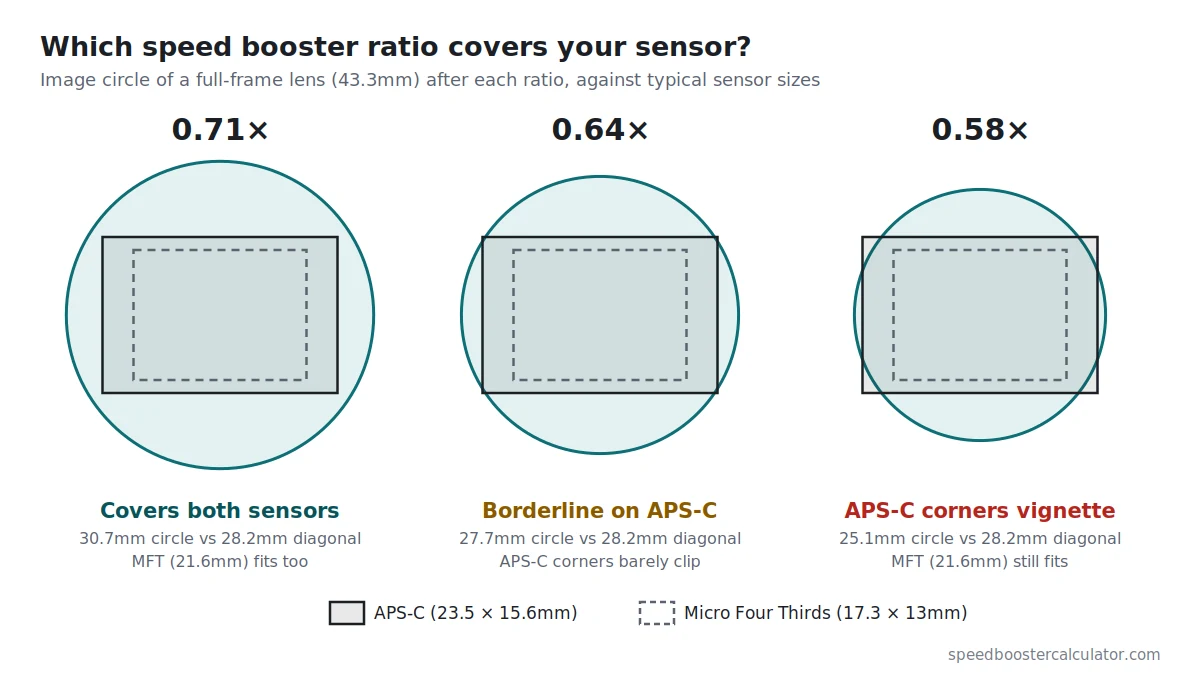
| Ratio | Image circle from a full-frame lens | APS-C Sony, Nikon, Fujifilm (28.2mm diagonal) | APS-C Canon (26.8mm) | Micro Four Thirds (21.6mm) |
|---|---|---|---|---|
| 0.71× | 30.7mm | Covers | Covers | Covers |
| 0.64× | 27.7mm | Borderline, corners barely clip | Covers | Covers |
| 0.58× | 25.1mm | Corner vignetting | Corner vignetting | Covers |
That’s why stronger ratios such as 0.64× and 0.58× are made for smaller sensors, while 0.71× is the general-purpose choice. This table is geometry only. Real adapters have their own optical design and tolerances, so treat borderline results as “test it” rather than “it will fail.”
Check your lens too. An APS-C lens projects a smaller circle than a full-frame lens, so it has less room to shrink. Suggestion of Motion’s comparison of Metabones Ultra and XL boosters notes that most APS-C lenses still cover the 1.42× crop of a 0.71× booster on Micro Four Thirds, so vignetting is rarely a problem there. Test your own lens before you rely on it.
Match the ratio to the sensor first, then worry about the maths.
What Is the Equivalent Focal Length With a Speed Booster?
Multiply the real focal length by the booster ratio, then by the camera crop factor. A 50mm lens with a 0.71× booster frames like about 53mm on APS-C and 71mm on Micro Four Thirds in full-frame terms.
Simply put, an equivalent focal length is a field-of-view label, not a real focal length. Metabones makes this point in its FAQ: the “35mm equivalent focal length” measures field of view only. The physical lens in that example is 35.5mm, and the 53mm figure only tells you how the frame looks.
| Lens focal length | APS-C 1.5×, no booster | APS-C 1.5× with 0.71× | Micro Four Thirds 2.0×, no booster | Micro Four Thirds 2.0× with 0.71× |
|---|---|---|---|---|
| 24mm | 36mm | 25.6mm | 48mm | 34.1mm |
| 35mm | 52.5mm | 37.3mm | 70mm | 49.7mm |
| 50mm | 75mm | 53.25mm | 100mm | 71mm |
| 85mm | 127.5mm | 90.5mm | 170mm | 120.7mm |
| 135mm | 202.5mm | 143.8mm | 270mm | 191.7mm |
Here’s a vintage example. A Helios 44-2 (58mm f/2) behind a 0.71× booster on Micro Four Thirds becomes a 41.2mm f/1.42 lens (58 × 0.71 and 2 × 0.71). Multiply by the 2.0× crop and it frames like an 82mm lens, with an equivalent aperture of f/2.84 for depth of field.
Equivalent focal length is the real focal length times two multipliers, and it describes framing only.
Quick Answers About Speed Booster Crop Factor
What Changes the Crop Factor When You Add a Speed Booster?
Simply put, the booster shrinks the lens’s image before the sensor records it, so the sensor captures more of the scene. The sensor itself doesn’t change. Only the combined field of view does, which is why the new crop factor is the camera’s figure multiplied by the ratio. It matters most when you adapt full-frame lenses to a crop sensor and want to know what framing you’ll actually get.
Speed Booster Crop Factor at a Glance
| Aspect | Details |
|---|---|
| Symptom | Unsure what crop factor or equivalent focal length applies after adding a booster |
| Root Cause | The camera crop and the booster ratio both scale the field of view, but people apply only one of them |
| Fix | Multiply camera crop by ratio, then multiply the real focal length by that combined figure |
| Performance Gain | APS-C 1.5× becomes 1.07× and Micro Four Thirds 2.0× becomes 1.42× with a 0.71× booster, plus about one stop of exposure |
| Applies To | Mirrorless APS-C and Micro Four Thirds cameras using full-frame lenses, or APS-C lenses with a large enough image circle |
When Does This Apply?
It applies when you adapt lenses made for a larger sensor, such as full frame, to an APS-C or Micro Four Thirds mirrorless camera through a focal reducer. It doesn’t apply to native crop-sensor lenses, to a plain adapter with no glass, or to a full-frame body, where boosters aren’t compatible.
Does a Video Crop Mode Change the Math?
Yes. Use the crop factor of the mode you’re recording in, not the sensor’s headline figure. Many cameras crop the sensor further for 4K or high frame rates, and the booster ratio multiplies that larger number.
Suggestion of Motion’s Panasonic GH4 example shows it clearly. In 4K, a 0.71× booster gives a combined crop of 1.63×, similar to a Canon APS-C camera. A stronger 0.64× booster brings it back to about 1.4×, the figure 4K shooters were used to in HD. The right ratio depends on the recording mode, not just the camera.
For your own camera, check the manufacturer’s crop figure for the exact recording mode, then type it into the crop factor box of the calculator. Our calculator accepts any value from 0.1 to 10, so custom video crops work. Always apply the crop of the mode you actually shoot in.
How Close Does APS-C Get to Full Frame With a Booster?
Very close for framing. For APS-C to full frame, a 0.71× booster gets you most of the way: the view ends up about 7% narrower than full frame on Sony, Nikon and Fujifilm bodies (1.07×) and about 14% narrower on Canon APS-C (1.14×).
Aperture follows the same pattern. The full-frame equivalent aperture is the f-number times the ratio times the crop factor, so an f/1.8 lens on 1.5× APS-C with a 0.71× booster behaves like f/1.92 for depth of field. The exposure and total-light side is more subtle, and we break it down in do speed boosters really add light.
What still differs is the adapter itself. Extra glass absorbs a little light and can soften the edges, and quality varies by brand. The framing gets close to full frame, but the optics are never free.
Frequently Asked Questions
Does a speed booster change the crop factor of the sensor?
No, the sensor's crop factor is fixed by its size. The booster changes the combined crop factor of the whole setup: camera crop times ratio. A 2.0× Micro Four Thirds camera with a 0.71× booster behaves like a 1.42× camera for field of view.
What is the crop factor of a Micro Four Thirds camera with a 0.71x speed booster?
1.42×, from 2.0 × 0.71. Metabones lists 1.42× for its ULTRA booster on a full Micro Four Thirds sensor and often describes it as about 1.4×. A 50mm lens then frames like roughly 71mm in full-frame terms.
What is the crop factor of an APS-C camera with a 0.71x speed booster?
About 1.07× on Sony, Nikon and Fujifilm bodies (1.5 × 0.71) and about 1.14× on Canon APS-C (1.6 × 0.71). Either result is close to a full-frame field of view.
Can a speed booster take the crop factor below 1.0?
Mathematically yes, for example 1.5 × 0.64 = 0.96. In practice a full-frame lens can't project a wider view than its image circle, so you would see vignetting. For full-frame lenses, a combined crop near 1.0 is the practical limit.
Does a speed booster change the focal length printed on the lens?
The marking stays the same, but the effective focal length shrinks by the ratio. A 50mm lens behaves like 35.5mm with a 0.71× booster. The equivalent figure, 53mm on APS-C, is then that value times the camera crop factor.
Is the 35mm equivalent focal length a real focal length?
No. Metabones points out that it measures field of view only. The real focal length of your lens and booster combination is the shorter number, and the equivalent figure just tells you what framing to expect compared with a full-frame camera.
Do I use a different crop factor in 4K or video crop mode?
Yes. Use the crop factor of the exact recording mode. If 4K crops the sensor more, the combined figure rises accordingly. In one GH4 example, a 0.71× booster gives 1.63× in 4K, so check your own camera's figure before calculating.
What speed booster ratio gives a full-frame field of view on APS-C?
About 0.67× for a 1.5× camera, from 1 ÷ 1.5, and about 0.63× for a 1.6× camera. The common 0.71× lands at 1.07× or 1.14×, which is close and keeps the image circle covering the sensor.
So that’s the speed booster crop factor in one line: multiply your camera’s crop by the ratio, and use the result to find your framing. A 0.71× booster takes APS-C from 1.5× to about 1.07× and Micro Four Thirds from 2.0× to 1.42×, as long as your lens and sensor are matched to the ratio. Check the image circle before you chase a lower number.
It’s one more piece of the lens-maths picture: how focal length, aperture and crop factor combine when you adapt lenses across sensor sizes. Adapters and prices keep changing, so confirm the ratio and coverage on the maker’s current spec sheet in 2026 before you buy.
To run the numbers for your own lens, camera and ratio, open the speed booster effective aperture calculator. Bookmark this page for the crop factor and coverage tables, and share it with the friend who keeps asking what their adapter really does to the frame.