
Understanding your speed booster effective aperture is essential when you mount a full-frame lens on a crop-sensor camera. A wide 35mm becomes a tighter field of view (about 52mm on APS-C), and the depth of field feels different. Add a focal reducer and the maths gets harder, because you are also changing how much light lands on each part of the sensor.
Many videographers and photographers struggle to work out their real exposure and framing when adapting vintage or full-frame glass to Micro Four Thirds (MFT) or APS-C. To skip the manual formulas, use the speed booster calculator.
Last updated:
Table of Contents
How a Focal Reducer Changes Your Lens
Simply put, a focal reducer is an optical adapter with glass elements that shrinks a lens’s projected image circle. By condensing the light to fit a smaller sensor, it widens your field of view and concentrates the incoming light.
With a plain adapter (no glass), a crop sensor only records the centre of a full-frame lens’s image circle, and the rest of the light is wasted. A focal reducer captures that light and focuses it down onto the sensor. It is the opposite of a teleconverter, which magnifies the centre of the image and loses light.
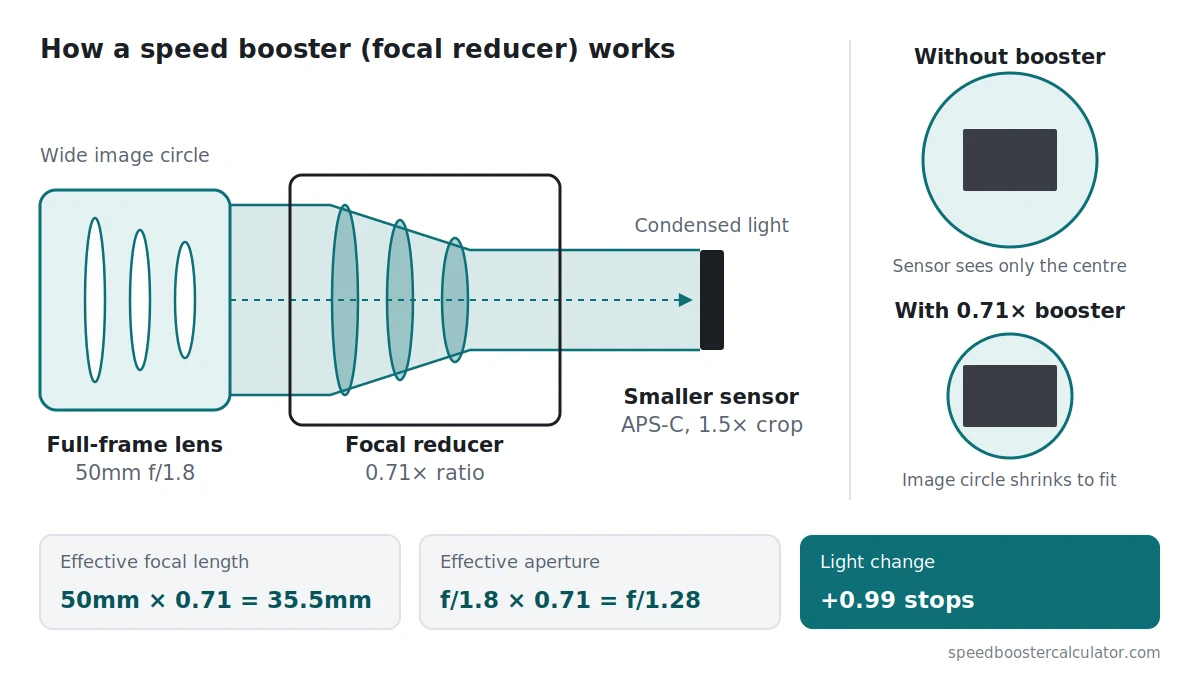
Calculating Your Speed Booster Effective Aperture
Your speed booster effective aperture is the new f-number after the adapter has condensed the light. The formula is one multiplication:
Effective aperture = lens f-number × booster ratio
Example: a 50mm f/4 lens with a 0.71× focal reducer gives 4 × 0.71 = 2.84, so the lens now gathers light like an f/2.8 lens. The gain in stops is −2 × log2(ratio), which is +0.99 stops at 0.71×, +1.29 stops at 0.64× and +1.57 stops at 0.58×.
That extra light lets you shoot at a lower ISO in dim scenes, which means cleaner footage with less noise. For a table of common ratios, see the speed booster ratio table.
Do Speed Boosters Actually Give You More Light?
Yes. A speed booster concentrates the light from the lens’s larger image circle onto a smaller area of the sensor, so exposure brightness goes up by the amount shown above.
The lens itself does not change: its aperture blades and entrance pupil are the same size. What changes is the f-number and field of view measured at the sensor. Real gain is slightly below the theoretical figure because the extra glass absorbs some light, which is why cinema users quote T-stops. For the underlying physics, the Wikipedia article on the f-number is a good foundation.
For the full breakdown of brightness, total light and depth of field, read do speed boosters really add light.
Calculating Full-Frame Equivalent Focal Length
To find the full-frame equivalent you combine two multipliers: the booster ratio and the camera’s crop factor.
First multiply the lens focal length by the booster ratio: a 50mm lens with a 0.71× booster becomes 35.5mm. Then multiply by the crop factor. On a Micro Four Thirds camera (2.0× crop), 35.5mm × 2.0 = 71mm full-frame equivalent field of view.
For depth of field, apply the same crop factor to the effective aperture. On APS-C (1.5×), a 50mm f/1.8 lens with a 0.71× booster is 35.5mm f/1.28 on the camera, or 53.25mm f/1.92 in full-frame terms.
This two-step calculation is where most people slip, which is why an automated speed booster effective aperture calculator saves time on set.
For combined crop factors and which ratio fits your sensor, see the speed booster crop factor table.
Quick Answers About Speed Boosters
What Causes Edge Softness When Adapting Lenses?
Simply put, a booster makes the smaller sensor record the outer edges of the lens’s full image circle, which a plain adapter would have cropped away. Vintage lenses are often soft at the extreme edges, and the focal reducer squeezes those edges into your frame.
Speed Booster vs Teleconverter at a Glance
| Aspect | Speed Booster (Focal Reducer) | Teleconverter (Extender) |
|---|---|---|
| Primary function | Widens field of view | Narrows field of view |
| Light impact | Gains about 1 to 1.6 stops (0.71× to 0.58×) | Loses about 1 to 2 stops (1.4× to 2.0×) |
| Focal length | Decreases (e.g. 0.71×) | Increases (e.g. 1.4× or 2.0×) |
| Typical use | Adapting full-frame lenses to smaller sensors | Wildlife and sports photography |
When Does This Apply?
The speed booster effective aperture calculation applies when you mount a lens designed for a larger sensor (full frame or medium format) on a camera with a smaller one (APS-C, Super 35 or Micro Four Thirds). It does not apply to native crop-sensor lenses.
Frequently Asked Questions
What is a 0.71x focal reducer equivalent?
A 0.71× focal reducer gains about one stop of light (0.99 stops) and widens the field of view. On a 1.5× APS-C camera the combined crop factor is about 1.07, so the booster almost cancels the crop and gives close to a full-frame field of view.
Does a speed booster change depth of field?
Yes. It lowers the f-number and widens the field of view, so at the same framing the depth of field matches a full-frame lens at f-number × ratio × crop factor. Example: a 50mm f/1.8 lens with a 0.71× booster on a 1.5× camera behaves like 53mm f/1.92 in full-frame terms.
Can I use a speed booster on a full-frame camera?
Normally no. A speed booster shrinks the lens image circle to fit a smaller sensor. On a full-frame camera the shrunken image circle no longer covers the sensor, which causes heavy vignetting.
Will autofocus work with a focal reducer?
It depends on the adapter. Electronic boosters can pass autofocus and aperture control between compatible mounts, though autofocus is often slower than with native lenses. Manual adapters have no electronic communication at all.
Does a focal reducer reduce image quality?
It can. Every extra glass element between lens and sensor risks quality loss. Premium adapters stay sharp, but budget options often add chromatic aberration, flare and corner softness.
What is the difference between T-stop and F-stop?
An f-stop is calculated from focal length and aperture diameter. A T-stop measures the light that actually reaches the sensor after absorption in the glass. A booster's real light gain shows up in T-stops and is usually slightly below the theoretical value.
Why does my lens still look longer than its marked focal length on Micro Four Thirds?
The camera crop factor is larger than the booster's reduction. A 50mm lens with a 0.71× booster becomes 35.5mm, and on a 2.0× Micro Four Thirds camera that is a 71mm full-frame equivalent field of view.
Knowing how to calculate speed booster effective aperture, together with crop factors and focal lengths, lets you make better gear decisions. Check the numbers before a shoot: open the speed booster calculator.